

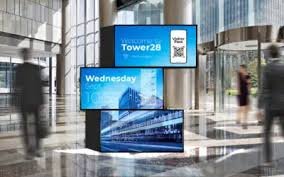
The business areas are evolving at a high rate. The current business environment is very competitive with limited attention to customers and high expectations. It is no longer sufficient to use a printed banner, a static poster, and conventional signage to get the message across. The trend has enhanced the use of digital signages in the business world.
Through retail shops and shopping centers to the company offices and exhibition areas, digital signage has emerged as an effective means of communication, branding and communication with customers. Its capability to provide dynamic and real-time content makes it a critical element of the contemporary commercial approaches.
The Digital Signage in Commercial Environments
Digital signage: electronic display systems that are used to display multimedia information like videos, images, animations, and real-time information. Digital displays are much easier to update in real-time, have the ability to be set at a distance and are tailored to specific audiences, unlike traditional signage.
In business premises, digital signage is usually applied to:
- Adverts and promotions.
- Brand storytelling
- Wayfinding and navigation
- Internal communication
- Product information
Technology vendors such as Ikinor create digital signage systems that are robust enough to fit various commercial purposes without compromising the visual consistency and dependability.
The reason why digital signage is becoming so popular
The development of digital signage in the business environment has been triggered by a number of elements:
- Shifting Consumer Expectations.
- Contemporary customers are looking at the images and interactive experience. Online displays are inherently catchy, and they are more informative than posters.
- Real-Time Communication Requirement.
The businesses must be able to edit messages at a very fast rate-be it promotion, announcement or even operational notice. Digital signage enables real time updates in various locations.
Cost Efficiency Over Time
Although the initial expenditure can be more in comparison to the printed signs, the digital displays will lower the printing and replacement expenses in the long term.
Major Trends that define the Digital Signage in Commercial Spaces.
Flooring Standing Displays in Earthquake-prone Areas.
The use of commercial floor-standing digital signage, especially in malls, showrooms, hotels, and office lobbies, is becoming one of the most obvious ones. These are best used in places where a wall mount is not feasible or where it is necessary to have a view of more than one angle.
They are often used for:
- Promotional campaigns
- Event schedules
- Product launches
- Brand storytelling
They are sleek and are portable thus a favorite in dynamic commercial layouts.
Flexible and Portable Display
Companies are also more willing to use displays which are movable and rearrangeable as required. This has prompted the need to have portable digital signage systems that can be used to help in flexible layouts.
The environmentally-friendly solutions such as Ikinor portable smart display solutions are created to be used in the settings where the flexibility is necessary, such as exhibitions, pop-up stores, and shared workspaces.
Personalization and Scheduling of Content.
Online signage systems have enabled companies to:
- Time or day schedule.
- Message customization by location.
- modify information to seasonal campaigns.
- Such degree of control makes messaging relevant and timely.
- Business Systems integration.
Digital signage is no longer autonomous. It is being progressively combined with:
- POS systems
- Inventory platforms
- Corporate communication tools.
Through this kind of integration, businesses are able to present real-time information like availability of a product, change of price or internal notification.
Applications of Digital Signage in Commercial Spaces in Real Life
Retail Stores
One of the largest users of digital signage is retail. Digital displays in Stores are used to:
- Highlight promotions
- Showcase new arrivals
- Provide product details
- Enhance in-store ambiance
Standup displays are best used in areas close to entrance and advertising spaces that will attract customers to get into the store further.
Shopping Complexes and Malls
Digital signage is better in big business premises because it:
- Putting out store directories.
- Promoting events and sales
- Wayfinding facilities.
- The mall management can also update digital displays centrally and without handwork.
- Corporate Offices and Business Centers.
Incorporates digital signage in corporations that:
- Internal communication
- Company announcements
- Visitor guidance
- Brand presentation
Digital displays are used to generate a professional and modern appeal in meeting rooms and other areas where clients are received.
Exhibitions and Trade Shows
Exhibitions and other events demand very dynamic display systems. Portable digital signage will help exhibitors to:
- Present product demos
- Share promotional videos
- Real-time updating of messages.
This is because of the ease of use that makes digital signage more popular among such commercial temporary arrangements.
Restaurants and Cafes
Digital menus and promotional screens in food and beverage areas:
- Improve order accuracy
- Reduce menu update costs
- Enhance visual appeal
Dynamic pricing and limited-time offers are also promoted with the help of the digital displays.
The Factor of Design and User Experience
A successful digital signage does not only depend on the screen, but the manner in which information is shown.
The major design considerations are:
- Clear typography
- High-contrast visuals
- Consistent branding
- Logical content flow
Firms such as Ikinor focus on the quality of hardware and user interface to make the screens user friendly and attractive.
Information Findings and KPI
The digital signage systems available in the present day have analytics features which enable a business in knowing:
- Content engagement levels
- Peak viewing times
- Interaction patterns of the audience.
Such insights enable the businesses to maximize the content and enhance ROI in the long run.
Challenges and Considerations
Digital signage has numerous advantages but businesses have to think about:
- Initial setup costs
- Responsibilities on content management.
- Hardware durability
- Network reliability
Selecting an appropriate technology partner is an important aspect in the determination of success in the long term.
Sustainability and Environmental Impact
Digital signage helps in promoting sustainability by cutting:
- Paper waste
- Printing frequency
- Physical signage disposal
In the long run, this helps in making the commercial operations more responsible towards the environment.
The Digital Signage Future in Business Areas
Digital signage will keep on evolving with the advancement in technology. Future trends may include:
- Recommendations that are AI-based.
- Touchless interaction
- Deeper personalization
- Native mobile app development.
Business premises incorporating the use of digital signage are in better positions to satisfy its customers in the future.
Conclusion
In the contemporary business world, digital signage has become a very critical communication device. Its capability to provide dynamic, interactive and real time content makes it much better than conventional signage.
New displays solutions such as Ikinor portable smart display solutions are flexible and can be adapted to the changing requirements of businesses and the display is now commercially available, including through floor-based digital signage in busy places.
Having trusted technology providers like Ikinor, the commercial spaces will be able to execute digital signage strategies and ensure better visibility, communication, and make the environment more interactive to both the customers and the employees.
