

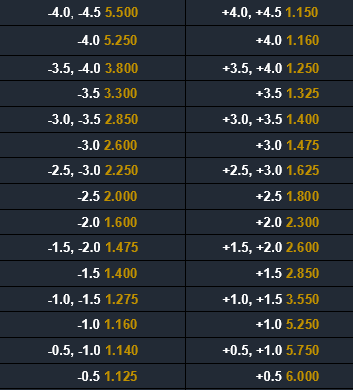
Economic polarization in modern football reaches its apex in domestic competitions where a single state-backed giant operates alongside historically modest provincial clubs. During the 2019/20 French Ligue 1 campaign, the wage bill and operational budget of Paris Saint-Germain exceeded the combined financial resources of the bottom half of the division. While casual market participants assume that massive payroll superiority translates directly into linear margin-of-victory dominance, quantitative betting markets operate on point spreads designed to balance risk. Analyzing how immense financial gaps warp bookmaker handicap lines reveals a persistent structural inefficiency: public overvaluation of pure financial power consistently creates profitable opportunities to back fiscally constrained underdogs on inflated spreads.
The Economic Architecture of Ligue 1 and Market Pricing Mechanics
The financial stratification of French football in 2019/20 was divided into three distinct economic tiers: an elite hyper-budget heavyweight at the summit, a volatile mid-tier of established clubs with moderate commercial backing, and a large cluster of low-budget operations relying primarily on youth development and structural cohesion. Bookmakers construct opening handicap lines by factoring in baseline squad valuations, which creates a natural mathematical distortion. Because market makers anticipate heavy recreational capital flowing toward squads with nine-figure payrolls, opening spreads are shaded beyond the true expected goal differential (xG).
This mechanical shading forces elite financial powerhouses to cover extreme multi-goal spreads (-1.75 to -2.75) week after week. While a squad with five times the opposing payroll will win the match outright at a high statistical frequency, covering large handicap cushions requires sustained offensive urgency across all ninety minutes. Low-budget clubs, aware of their technical deficits, construct specialized defensive game plans aimed specifically at limiting margin of defeat, systematically compressing the goal differential and rewarding plus-handicap backers.
Financial Tiers vs. Handicap Performance in the 2019/20 Season
Evaluating the betting impact of budget disparity requires cross-referencing operational budgets against Asian Handicap cover rates. Raw league position reflects absolute quality, whereas handicap performance measures efficiency relative to market expectation.
The comparative dataset below categorizes the financial hierarchy of the 2019/20 Ligue 1 campaign and contrasts annual operating budgets with season-long Asian Handicap cover efficiency.
| Financial Tier | Representative Club | Operating Budget (€M) | Final Table Position | Asian Handicap Cover % | Primary Market Distortion |
| Mega-Budget | Paris Saint-Germain | €637M | 1st | 51.8% | Spreads inflated by public brand bias |
| Upper-Middle | Olympique Lyonnais | €310M | 7th | 39.3% | Wage bill overvalued relative to cohesion |
| Middle-Tier | Stade Rennais | €65M | 3rd | 64.3% | Tactical discipline outperforming valuation |
| Low-Budget | Stade de Reims | €45M | 5th | 60.7% | Extreme defensive ROI against large budgets |
| Micro-Budget | Nîmes Olympique | €27M | 18th | 46.4% | Physical aggression covering home spreads |
The empirical metrics confirm that budgetary size does not correlate with wagering profitability. Paris Saint-Germain generated an essentially break-even 51.8% cover rate despite winning the title comfortably, while Lyon’s second-largest budget yielded a disastrous 39.3% cover rate. Conversely, low-to-mid budget clubs like Stade Rennais and Stade de Reims generated elite returns because the market consistently priced their fixtures around financial status rather than tactical baseline metrics.
Mechanisms of Tactical Equalization by Low-Budget Units
Faced with massive individual skill deficits, low-budget managers abandon open-field possession battles to implement ultra-compact 5-4-1 low blocks. By defending exclusively within thirty meters of their own goal, underdogs eliminate the space behind their back line that elite forwards need to accelerate. This tactical containment reduces high-probability central shots, keeping scorelines within one-goal margins and allowing underdogs to cash positive Asian Handicap tickets even in defeat.
The Payroll Trap: Why High-Wage Squads Fail to Cover Extended Spreads
High-wage clubs carry structural liabilities that frequently undermine their ability to deliver blowout victories in domestic league play. Elite squads with dozens of international players face chronic schedule congestion across domestic cups, league campaigns, and continental tournaments, forcing managers to manage physical load dynamically.
Several specific operational factors explain why heavily bankrolled favorites routinely fall short of extended spreads:
- Game-Management Downshifts: After securing a two-goal lead, elite sides routinely drop their pressing tempo to conserve physical energy for upcoming European fixtures.
- Late-Game Star Substitutions: Removing primary attacking focal points after sixty minutes to protect them from injury, blunting offensive efficiency in the final quarter of the match.
- Disproportionate Risk Aversion: Opponents refusing to push forward even when trailing 1-0 or 2-0, maintaining defensive shape to avoid embarrassing blowouts.
- Underestimated Squad Chemistry Deficits: Expensive collections of individual talent struggling to break down cohesive, well-drilled defensive units that have trained together for multiple seasons.
Recognizing these operational bottlenecks allows bettors to see past player transfer valuations and identify fixtures where an expensive favorite will settle for a low-margin victory.
When market participants analyze pricing inefficiencies across financial tiers, engaging with an advanced web-based service provides the necessary line clarity. For analysts evaluating Asian Handicap spreads on ufabet ufa168, comparing opening goal lines across French fixtures reveals how financial dominance is frequently priced beyond fair value, creating actionable contrarian opportunities on low-budget underdogs.
The Mid-Table Value Sweet Spot: Structured Clubs Outperforming Valuations
The greatest return on investment in financially stratified leagues exists within mid-tier clubs that combine modest wage structures with elite tactical coaching. In 2019/20, Stade de Reims operated on one of the smallest budgets in the division (€45M), yet conceded the fewest goals in the league alongside PSG (21 goals in 28 matches).
Because bookmakers rely heavily on macro-level team ratings that factor in squad commercial value, clubs like Reims consistently received generous underdog pricing (+1.0, +1.5) against financially superior sides. Sharp bettors who ignored financial prestige and focused on Reims’ league-leading expected goals against (xGA) metrics extracted massive value across positive handicap spreads throughout the season.
A broader look at digital gaming hubs confirms that financial inequality creates predictable retail biases across all wagering formats. When observing recreational behaviors across interactive platforms that feature sportsbooks alongside casino online products, the persistent tendency of public bettors to overvalue high-profile payrolls distorts point spreads, allowing sharp players to systematically profit from disciplined mathematical valuation.
Conditional Performance of Low-Budget Home Underdogs
When a micro-budget club hosts a mega-budget favorite on a degraded winter pitch or following a continental fixture, the physical and motivational gap narrows significantly. The combination of intense home crowd energy, physical tackling, and localized pitch familiarity frequently enables the home underdog to hold the expensive visitor to a narrow one-goal victory or an outright draw, securing a complete win on +1.5 handicap lines.
Analytical Pitfalls: When the Financial Disparity Angle Fails
While backing low-budget underdogs against bloated payrolls is mathematically robust, specific operational conditions can trigger blowout scorelines that destroy plus-handicap positions. Identifying these risk conditions is vital for risk mitigation.
The primary breakdown points for the low-budget thesis include:
- Early Concessions That Force Open Play: A micro-budget team conceding inside the first ten minutes, which shatters their low-block structure and forces them into an open game they lack the technical quality to survive.
- Severe Defensive Injuries: A low-budget side missing its primary central defensive anchor, exposing an extreme drop in reserve quality that elite attackers exploit ruthlessly.
- Severe Title Race Pressure: An elite powerhouse needing goal differential on the final matchdays, removing their usual tendency to ease off the throttle in the second half.
- Disciplinary Implosions: A low-budget side accumulating early cards due to physical overcompensation, eventually receiving a red card that collapses their defensive containment.
Filtering fixtures through these qualitative risk checks ensures that positive handicap positions are taken only when the underdog possesses the structural resilience required to absorb continuous pressure.
Summary
Extreme financial disparity in Ligue 1 serves as a major driver of market mispricing on Asian Handicap boards. Because casual public money disproportionately backs mega-budget brands, opening spreads on elite favorites are consistently inflated beyond true sporting probability. During the 2019/20 campaign, disciplined low-to-mid budget clubs like Stade Rennais and Stade de Reims generated superior handicap returns by utilizing compact low blocks to neutralize high-wage attacking units. Profitable long-term wagering in financially unequal leagues requires looking past club payrolls, identifying tactical containment mechanisms, and systematically capturing the value offered on well-structured underdogs.
