

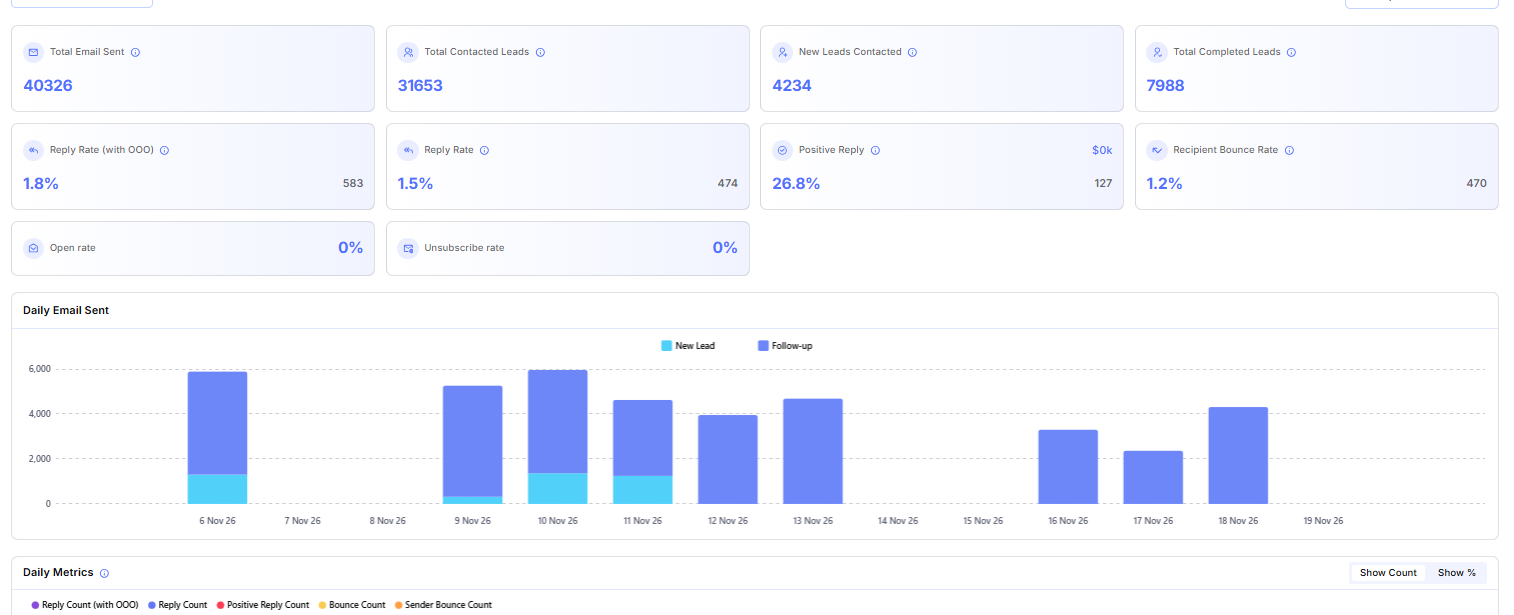
When someone launches a cold email campaign, one of the first things they usually check is the reply rate.
It’s understandable.
You send emails, people respond, and the percentage appears to tell you whether the campaign is working.
But reply rate doesn’t tell the whole story.
A campaign can generate plenty of replies without producing a single qualified sales opportunity.
Another campaign might have a lower reply rate but generate conversations with exactly the people you want to reach.
I’ve worked with cold email campaign management and performance reporting using outreach tools including PlusVibe.
When reviewing campaign results, I prefer looking beyond a single percentage.
Here’s why.
1. Understand What Reply Rate Actually Measures
Reply rate generally measures the proportion of contacted prospects or sent messages that generate replies, depending on the platform’s reporting method.
That distinction matters.
For example, suppose you contact 1,000 unique prospects and receive replies from 30 people.
Your prospect-based reply rate is:
30 ÷ 1,000 × 100 = 3%.
That sounds straightforward.
However, some reporting systems calculate rates using different denominators or include certain automated responses.
Before comparing campaigns, make sure you understand how the metric is calculated.
Otherwise, two campaigns with similar results might appear very different.
2. Not Every Reply Is a Positive Reply
This is one of the biggest reasons I don’t rely on reply rate alone.
Imagine sending 2,000 emails and receiving 100 replies.
That’s a 5% reply rate if the denominator is the 2,000 messages sent.
But what if the responses include:
- 30 out-of-office messages
- 25 unsubscribe requests
- 20 people saying they’re not interested
- 15 people asking unrelated questions
- 10 people genuinely interested in the offer
The campaign has generated 100 replies, but only 10 show potential commercial interest.
That gives a very different picture of performance.
The example is hypothetical, but it illustrates why response classification is important.
A campaign with fewer total replies but more relevant conversations may be much more valuable.
3. Track Positive Replies Separately
A positive reply is generally a response that indicates some level of genuine interest.
For example, someone might ask for pricing, request a demonstration, or agree to discuss the service.
However, even positive replies aren’t necessarily qualified opportunities.
Someone might be interested but work at a company outside your target market.
Another person might want information but have no purchasing authority.
I recommend reviewing replies in stages.
First, determine whether the response is positive.
Next, assess whether the person and company match your targeting criteria.
Finally, track whether the conversation progresses toward a meaningful business outcome.
This approach makes reporting more useful than simply counting every response.
4. Use PlusVibe to Review Campaign Activity
An outreach platform is useful because it brings campaign activity into a manageable workflow.
When working with PlusVibe, campaign information can be reviewed alongside sending operations.
Instead of focusing only on the total number of emails sent, examine how prospects respond.
Look for patterns across campaigns and audiences.
For example, are finance directors responding differently from company owners?
Is one industry generating more relevant conversations than another?
Are follow-up messages producing useful responses?
These questions help turn campaign data into decisions.
5. Compare Campaigns Using Consistent Metrics
Let’s consider two hypothetical campaigns.
Campaign A contacts 1,000 prospects and receives 50 replies.
Campaign B contacts 1,000 prospects and receives 25 replies.
At first glance, Campaign A appears more successful.
But suppose Campaign A produces only five positive responses, while Campaign B produces 12.
The picture changes.
Campaign A has a 5% reply rate and a 0.5% positive-response rate relative to contacted prospects.
Campaign B has a 2.5% reply rate and a 1.2% positive-response rate relative to contacted prospects.
Campaign B has fewer replies overall but more than twice as many positive responses.
That’s why I prefer reporting both total replies and meaningful positive responses.
The same principle applies when comparing different industries, audiences, and offers.
6. Look at Qualified Meetings
For appointment-setting campaigns, qualified meetings are often more important than replies.
A prospect might express interest but never schedule a call.
Another might book a meeting and fail to attend.
Someone else might attend but not match the client’s ideal customer profile.
These outcomes should be recorded separately.
A useful reporting process distinguishes between meetings booked, meetings attended, and meetings that satisfy the agreed qualification requirements.
This helps clients understand what they’re actually receiving from outreach.
It also prevents confusion when evaluating campaign performance.
For example, if a client is paying per qualified attended meeting, the number of positive replies alone doesn’t establish how much commission or payment is due.
7. Investigate Low Reply Rates Properly
When a campaign has a low reply rate, the immediate reaction is often to rewrite the email copy.
Sometimes that’s appropriate.
But poor results can have several causes.
The audience might be too broad.
The offer might not address an urgent problem.
The message might be unclear.
The sending infrastructure might also be experiencing deliverability issues.
I prefer checking the fundamentals before making major changes.
Start with the prospect data.
Then review delivery errors and available inbox placement evidence.
After that, evaluate whether the message is relevant and whether the call to action makes sense.
This prevents unnecessary changes to campaigns that may have problems unrelated to their wording.
8. Review Performance Over Time
Campaign results can vary from day to day.
A single day with no positive replies doesn’t necessarily mean the campaign has failed.
Similarly, a few positive responses immediately after launch don’t prove that the campaign will continue performing well.
I recommend reviewing trends over a meaningful period.
Compare campaigns using consistent definitions and similar reporting windows.
Also consider the number of prospects contacted.
A campaign that has reached only 50 people provides much less evidence than one that has reached several thousand.
Avoid making confident conclusions from very small samples.

9. Build Reports Around Business Outcomes
Clients generally don’t invest in outreach because they want to see a large number of emails sent.
They want business opportunities.
That means reports should explain what happened after messages were delivered.
A practical report might include unique prospects contacted, total replies, positive replies, qualified meetings booked, attended meetings, and important delivery problems.
It should also explain what changes are being considered and why.
This makes the report useful for deciding what to do next.
Final Thoughts
Reply rate is a useful metric, but it shouldn’t be the only measure of cold email success.
Positive replies, prospect quality, qualified meetings, and campaign reliability provide a more complete picture.
PlusVibe can help manage outreach activity, while careful reporting helps you understand what that activity means.
The goal isn’t simply to make more people respond.
It’s to start relevant conversations that can lead to meaningful business opportunities.
I always prefer looking at actual replies and conversations rather than just sending numbers. If you’re reviewing your own campaign performance, you can take a look at PlusVibe.
